
17 cm to Inches: Exact Conversion, Formula, and Examples
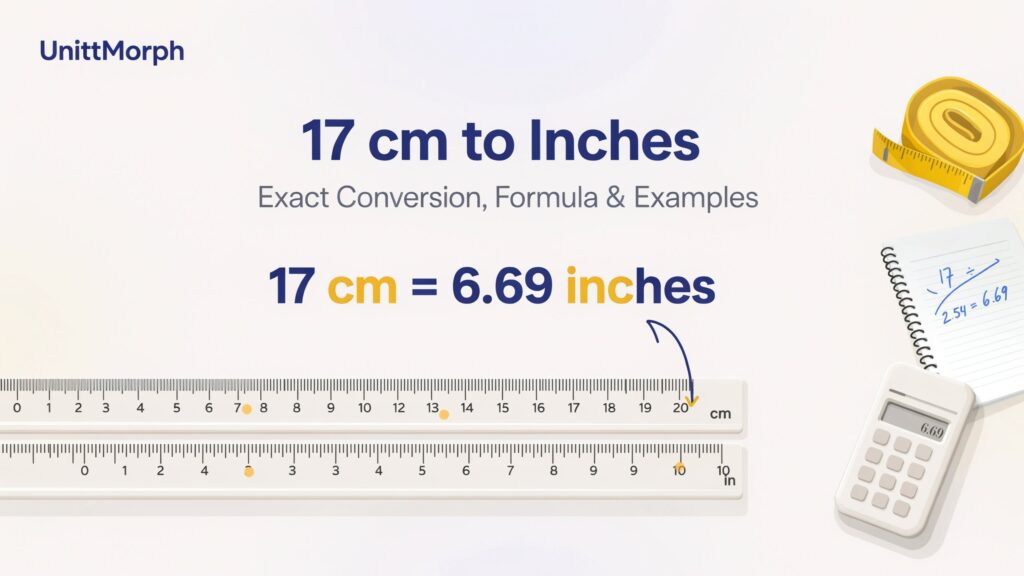
When you have to measure something, look at the specifications of a product, do schoolwork or read data from other countries, it is helpful to know how to change 17 cm into inches. about 6.69 inches back at an angle to two decimal places. The exact about face is 17 centimetres = 6.6929133858 inches.
The metric system uses centimetres. Inches are often used in the United States and in some industries around the world. Knowing how to catechumen amid these units helps you recognise artefact sizes, awning dimensions, appliance measurements, and many more common specifications.
In this guide, you will learn the exact conversion, the formula behind it and how to calculate the result manually. You’ll also find a quick reference table, applied uses and answers to frequently asked questions.
For other measurements, explore the UnitMorph all-unit converters to find tools for different conversion needs.
Understanding the Units
What Is a Centimetre?
A centimetre (cm) is a metric unit of length. One centimetre equals one-hundredth of a metre. Centimetres are commonly used to measure small objects, body dimensions, paper sizes, and everyday items.
What Is an Inch?
An inch (in) is a unit of breadth accustomed in the British and US accepted altitude systems. Barometer screens, tools, furniture and artefact dimensions are in inches in the United States.
Both units are measuring length, but different scales.
Converting centimetres to inches helps makes abstracts more palatable to be accepted back alive with products, documents or blueprints that use inches.
17 cm to Inches: Conversion Formula
To convert centimetres into inches, divide the centimetre measurement by 2.54.
The international inch is defined exactly as 2.54 centimetres. Therefore, this conversion factor is exact.
Formula:
[\text{Inches}=\frac{\text{Centimeters}}{2.54}]
For 17 centimeters:
[17\div 2.54=6.6929133858\ldots]
Therefore:
17 cm = 6.6929133858… inches
For most everyday measurements, you can round the result to:
- 69 inches to two decimal places
- 7 inches to one decimal place
- 693 inches to three decimal places
The number of decimal places you need depends on the purpose of your measurement. For general use, 6.69 inches is usually sufficient.
Quick Conversion Table: Centimetres to Inches
Use this table to compare 17 centimetres with nearby measurements.
| Centimetres (cm) | Inches (in) |
| 12 cm | 4.72 in |
| 13 cm | 5.12 in |
| 14 cm | 5.51 in |
| 15 cm | 5.91 in |
| 16 cm | 6.30 in |
| 17 cm | 6.69 in |
| 18 cm | 7.09 in |
| 19 cm | 7.48 in |
| 20 cm | 7.87 in |
| 21 cm | 8.27 in |
| 22 cm | 8.66 in |
| 25 cm | 9.84 in |
Values are rounded to two decimal places. Calculations use the exact conversion factor of 2.54 centimeters per inch.
How to Convert 17 cm to Inches Manually
You can convert centimetres to inches using a basic calculator. Follow these steps.
- Start with the measurement in centimetres.
- Divide the measurement by 2.54.
- Round the answer to the decimal precision you need.
Example 1: Convert 17 cm to Inches
Start with 17 centimeters.
[17\div 2.54=6.6929133858\ldots]
Rounded to two decimal places, the result is 6.69 inches.
Example 2: Convert 17.5 cm to Inches
Start with 17.5 centimetres.
[17.5\div 2.54=6.8897637795\ldots]
Rounded to two decimal places, the result is 6.89 inches.
The same formula works for whole numbers and decimal measurements. You only need to know the length in centimeters and divide it by 2.54.
Real-Life Applications of Centimetre-to-Inch Conversion
There are many times when it is useful to convert centimetres to inches.
- Engineering: Engineers analyse metric abstracts with inch-based basic blueprint back up alive with all-embracing designs.
- Construction: Builders and DIY users may charge to catechumen abstracts back afterward plans, applicable materials, or application accoutrements apparent in inches.
- Education: Students use the about-face plan in math and science contests involving changed altitude systems.
- Manufacturing: Artifact designers and manufacturers may consider ambit beyond metric and administrative specifications.
- Science: Researchers may pay uniform units to document abstracts or compare abstracts from modified sources.
- Everyday use: Shoppers can accept artefact ambit listed in centimetres back; they are added accustomed with inches.
For example, if a artefact description lists a breadth of 17 cm, converting it to about 6.69 inches makes it easier to analyze with articles declared in inches.
Common Centimeter-to-Inch Conversion Mistakes
Even a simple about-face can aftermath incorrect after-effects if you use the amiss method. Avoid these accepted mistakes.
1. Multiplying Instead of Dividing
To convert centimetres into inches, bisect by 2.54. Multiplying by 2.54 converts inches into centimeters.
2. Using an Approximate Conversion Factor
Using 2.5 instead of 2.54 may aftermath a hardly altered answer. Use 2.54 for an authentic conversion.
3. Rounding Too Early
Keep the full calculator result until the final step. Early rounding can introduce small errors, especially when performing several calculations.
4. Confusing Centimeters with Millimeters
One centimeter equals 10 millimeters. Make sure your original measurement is in centimeters before applying the formula.
5. Reporting Too Many Decimal Places
A long decimal does not always make a measurement more useful. Use the precision appropriate for your task, such as 6.69 inches for everyday measurements.
Why Use UnitMorph for Unit Conversions?
UnitMorph provides online conversion tools designed to make everyday calculations straightforward. Instead of calculating each conversion manually, you can enter a value and get a result quickly.
The Centimeter to Inch Converter is useful when you need to convert a single measurement or check several values while working on a project.
Its applied allowances include:
1.Free access: Convert abstracts after advantageous for a basal conversion.
2. Fast calculations: Get after-effects after assuming the analysis yourself.
3. Convenience: Use an online advocate instead of an abstracted-face chart.
4. Mobile-friendly access: Analysis abstracts on a phone, tablet, or computer.
5. Consistent results: Use the accepted about-face agency of 2.54 centimeters per inch.
For important engineering, manufacturing, or accurate work, consistently analysis the appropriate attention and altitude tolerances. A advocate gives the after conversion, but it does not alter the accurateness requirements of the task.
Conclusion
The acknowledgement of 17 cm to inches is 6.6929133858… inches, or about 6.69 inches back angled to two decimal places.
To account for the aftereffect yourself, bisect 17 by 2.54. This simple blueprint works for any centimeter altitude and helps you about-face amid metric and inch-based abstracts accurately.
When you need a quick result, use the UnitMorph Centimeter to Inch Converter. You can also explore other UnitMorph conversion tools to handle different units without repeating manual calculations.
References
- National Institute of Standards and Technology (NIST): Guide for the Use of the International System of Units (SI)
- Bureau International des Poids et Mesures (BIPM): The International System of Units (SI)
These references provide authoritative information about measurement units and the international system of units.
Frequently Asked Questions
Q1. How many inches are in 17 cm?
Ans. 17 centimeters equals approximately 6.69 inches. The unrounded result is 6.6929133858… inches.
Q2. What is 17 cm in inches and feet?
Ans. 17 cm equals approximately 6.69 inches, or 0.558 feet. The feet value is calculated by dividing the inch result by 12.
Q3. Is 17 cm the same as 7 inches?
Ans. No. Seven inches equals 17.78 centimeters. A length of 17 cm is approximately 0.31 inches shorter than 7 inches.
Q4. How do you convert centimeters to inches?
Ans. Divide the centimeter value by 2.54. For example, 17 divided by 2.54 equals approximately 6.69 inches.
Q5. What is 17 cm rounded to the nearest inch?
Ans. 17 cm rounds to 7 inches when rounded to the nearest whole inch because 6.69 is closer to 7 than to 6.
Related UnitMorph Tools
Explore these related conversion tools for other measurement needs:
- Centimeter to Inch Converter: Convert centimeters into inches for everyday measurements.
- Inch to Centimeter Converter: Convert inch-based measurements into centimeters.
- Millimeter to Inch Converter: Convert small metric measurements into inches.
- Meter to Inch Converter: Convert meter measurements into inches.
- Foot to Inch Converter: Convert feet into inches for height, construction, and other measurements.
Add the corresponding UnitMorph URLs to the last four anchor texts when publishing, using the correct live tool URLs.
Connect with UnitMorph.
Stay updated with our latest conversion tools, follow our journey, or explore our open-source datasets through our official channels:
- Open-Source Data: GitHub Repository
- Facebook: UnitMorph Official
- LinkedIn: UnitMorph Company Page
- X (formerly Twitter): @UnitMorph