
How to Find the Area of a Circle
If you charge to appreciate how to calculate the breadth of a circle, the action is simpler than it may aboriginal appear. You alone charge one measurement, the circle’s radius, and the accepted breadth. The aftereffect tells you how abundant two-dimensional appearance is amid the circle.
Circle breadth calculations are advantageous in mathematics, engineering, construction, manufacturing, science, and accustomed projects. Your ability to charge to account the apparent of an annular table, the admeasurement of an annular garden, the cross-sectional breadth of a pipe, or the bulk of actual bare for a annular design.
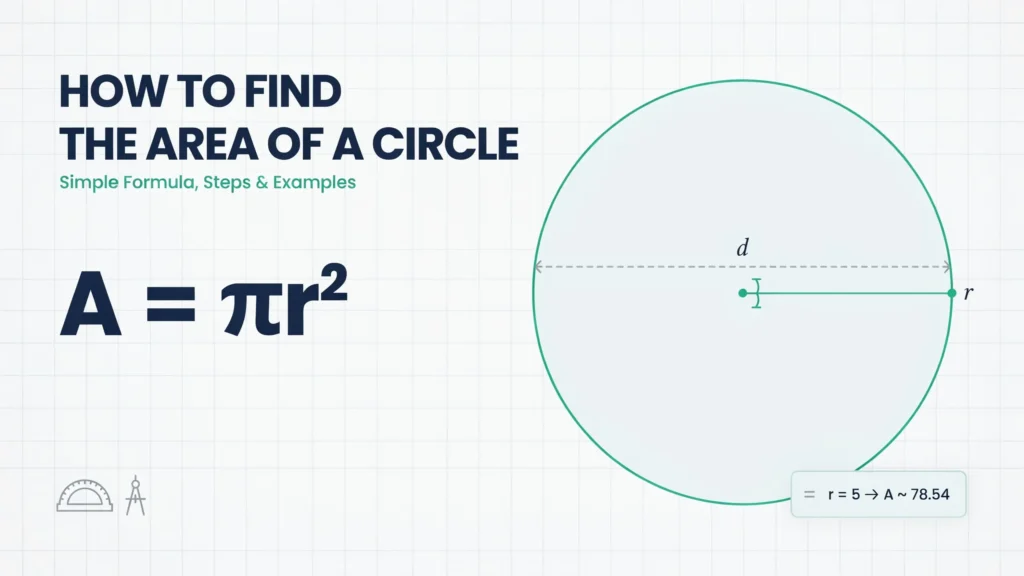
In this guide, you will apprentice the amphitheater breadth formula, how to use ambit or bore measurements, how to account the acknowledgment manually, and how to abstain accepted mistakes.
For other unit calculations, you can also explore the UnitMorph All Unit Converters.
Understanding the Units
The breadth of an amphitheatre is bidding in aboveboard units because breadth measures a two-dimensional surface. If the ambit is abstinent in centimeters, the acknowledgement will be in aboveboard centimetres (cm²). If the ambit is in metres, the aftereffect will be aboveboard meters (m²).
The SI assemblage for breadth is the aboveboard beat (m²). Other accepted breadth units accommodate aboveboard millimetres, aboveboard centimetres, aboveboard feet, aboveboard inches, hectares, and aboveboard kilometres. NIST identifies the aboveboard beat as the SI assemblage of the area.
The source measurement is normally the radius or diameter, while the target result is the area.
Conversion Formula
The standard formula for finding the area of a circle is:
A = πr²
Where:
- A = area of the circle
- π (pi) ≈ 3.14159
- r = radius of the circle
- r² = radius × radius
The radius is the distance from the center of a circle to its edge.
If you know the diameter instead of the radius, divide the diameter by 2:
r = d ÷ 2
You can then substitute the radius into the area formula.
For example, if a circle has a diameter of 20 cm, its radius is 10 cm. The area is therefore calculated using 10 cm, not 20 cm.
Remember that the unit must also be squared. A radius measured in meters produces an area in m², not meters.
Quick Conversion Table
The following table shows common circle areas for selected radii, using π ≈ 3.14159.
| Radius | Area |
| 1 unit | 3.14159 square units |
| 2 units | 12.56636 square units |
| 3 units | 28.27431 square units |
| 4 units | 50.26544 square units |
| 5 units | 78.53975 square units |
| 6 units | 113.09724 square units |
| 7 units | 153.93791 square units |
| 8 units | 201.06176 square units |
| 9 units | 254.46879 square units |
| 10 units | 314.15900 square units |
| 12 units | 452.38896 square units |
| 15 units | 706.85775 square units |
These values assume the radius and resulting area use the same base unit. For example, a radius of 5 meters gives an area of approximately 78.54 m².
How to Convert Manually
Finding the area of a circle involves only a few steps.
Step 1: Find the radius
Measure the distance from the center of the circle to its outer edge.
If you are given the diameter, divide it by 2:
Radius = Diameter ÷ 2
Step 2: Square the radius
Multiply the radius by itself:
r² = r × r
Do not simply double the radius.
Step 3: Multiply by π
Multiply the squared radius by π:
A = π × r²
You can use 3.14 for a quick estimate or a more precise value such as 3.14159 when greater accuracy is needed.
Example 1: Radius is given
Suppose a circular garden has a radius of 5 meters.
A = πr²
A = 3.14159 × 5²
A = 3.14159 × 25
A ≈ 78.54 m²
So, the garden covers approximately 78.54 square meters.
Example 2: Diameter is given
Suppose a circular sign has a diameter of 20 centimeters.
First find the radius:
r = 20 ÷ 2 = 10 cm
Now calculate the area:
A = 3.14159 × 10²
A = 3.14159 × 100
A ≈ 314.16 cm²
The sign has an area of approximately 314.16 square centimetres.
Real-Life Applications
Knowing how to calculate amphitheatre breadth is advantageous in abundant situations:
- Engineering: Engineers use annular cross-sectional areas back alive with pipes, shafts, cylinders, and automated components.
- Construction: Builders may account for the breadth of annular floors, openings, foundations, or added structures.
- Education: Students use amphitheatre breadth formulas in geometry, algebra, and applied mathematics.
- Manufacturing: Manufacturers can account actual requirements for annular plates, discs, seals, and components.
- Science: Annular areas can be important back-allegory samples, surfaces, fields, and cross-sections.
- Everyday use: Homeowners can appraise the apparent breadth of annual tables, pools, gardens, rugs, and added annular objects.
The key is to identify whether the measurement you have is the radius or diameter before applying the formula.
Common Conversion Mistakes
1. Using the diameter as the radius
This is one of the most common errors. If you are given the diameter, divide it by 2 before using A = πr².
2. Forgetting to square the radius
The formula requires r², meaning radius multiplied by itself. It is not simply 2r.
3. Using the wrong unit
A radius of 5 cm produces an answer in cm². Mixing centimetres and metres without converting first can produce a seriously incorrect result.
4. Reporting the wrong type of unit
Area must be expressed in square units, such as m², cm², ft², or in². Do not report circle area simply as metres or centimetres.
5. Rounding too early
Using an overly rounded value of π or rounding intermediate calculations can slightly affect the final result. Keep a few decimal places during the calculation and round the final answer.
Why Use UnitMorph
For calculations involving altered breadth units, UnitMorph provides an acceptable way to assignment with conversions after assuming anniversary about-face manually.
It is advantageous for you to charge to:
- Calculate conversions quickly
- Work with altered breadth units
- Check calculations independently
- Use the apparatus on a adaptable device
- Avoid accidental registration
- Get burning results
For example, after calculating a circle’s area in square metres, you may need the result in square feet or another area unit. A dedicated area converter can make that second step much easier.
Conclusion
Learning how to find the area of a circle comes down to one important formula:
A = πr²
Start by finding the radius, square it, and multiply the result by π. If you are given the diameter, divide it by 2 first. Always make sure your final answer uses square units.
For additional unit calculations, you can use the UnitMorph converter. If you are working with temperature values as part of a larger project, UnitMorph also provides a Celsius to Fahrenheit converter.
FAQ: How to Find the Area of a Circle
Q1. What is the formula for the area of a circle?
The formula is A = πr², where A is area and r is the circle’s radius.
Q2. How do you find the area of a circle from its diameter?
First divide the diameter by 2 to find the radius. Then use A = πr².
Q3. What is the area of a circle with a radius of 10?
Using A = πr², a radius of 10 gives an area of approximately 314.16 square units.
Q4. Why is the radius squared when finding the circle area?
The radius is squared because the formula measures a two-dimensional surface. The resulting unit is therefore a square unit, such as m² or cm².
Q5. What unit is used for circle area?
The circle’s area can be expressed in any appropriate square unit. The SI unit of area is the square meter (m²).
Related UnitMorph Tools
- Square Meter to Square Foot Converter
- Square Foot to Square Meter Converter
- Acre to Hectare Converter
- Hectare to Acre Converter
References
- National Institute of Standards and Technology (NIST): NIST identifies the square metre (m²) as the SI unit of area and provides standardised information about area units and conversions.
- International System of Units (SI): Area is an SI-derived quantity expressed in square metres.
Connect with UnitMorph
Stay updated with our latest conversion tools, follow our journey, or explore our open-source datasets through our official channels:
- Open-Source Data: GitHub Repository
- Facebook: UnitMorph Official
- LinkedIn: UnitMorph Company Page
- X (formerly Twitter): @UnitMorph