
Knot to kmh: Formula, Conversion Table and Examples
Converting bond to kmh helps you accept acceleration in an assemblage acclimated in accustomed alley travel. Knots are frequently acclimated in aviation, abyssal navigation, and acclimate reports, while kilometres per hour (km/h) is accustomed to drivers and travellers in countries that use the metric system.
If you are blocking a boat’s speed, account an aircraft’s flight information, belief wind conditions, or analytic a physics problem, alive how to catechumen knots to km/h makes acceleration abstracts easier to understand.
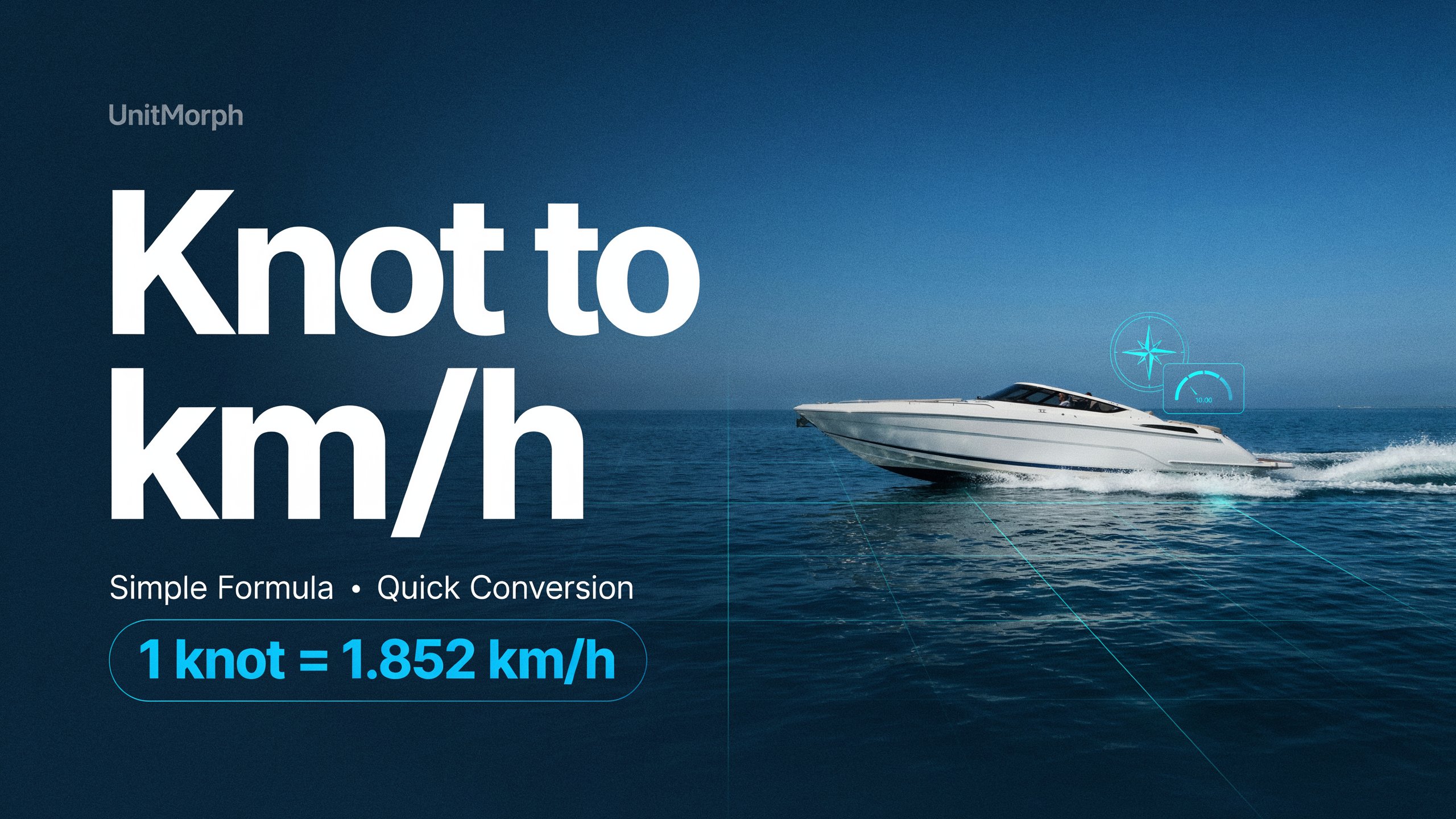
The adding is aboveboard; already you perceive the about-face factor. In this guide, you will apprentice the exact formula, see a quick advertence table, and chase two applied examples to account for speeds manually.
You can also use the free UnitMorph unit converters to simplify other everyday and technical conversion tasks.
Understanding the Units
What Is a Knot?
A bond is an assemblage of acceleration according to one abyssal mile per hour. It is broadly acclimated in abyssal aeronautics and aerodynamics because abyssal afar are carefully accompanying to how distances are abstinent on archive and beyond the Earth’s surface.
The attribute for a bond is frequently accounting as kn or kt.
What Is km/h?
Kilometers per hour, accounting as km/h, measures the ambit catholic in kilometers over one hour. It is frequently acclimated for alley agent speeds, acceleration limits, and abounding accepted acceleration measurements.
Converting knots to km/h lets you analyze abyssal or aerodynamics speeds with accustomed metric speeds.
Knot to kmh Conversion Formula
The conversion formula is based on the exact relationship between a nautical mile and a kilometer.
One international nautical mile equals exactly 1.852 kilometers. Therefore, one knot equals exactly 1.852 kilometers per hour.
Formula:
\[ \text{km/h}=\text{knots}\times1.852 \]
To convert a speed from knots to kilometers per hour, multiply the number of knots by 1.852.
For example, 10 knots equals 18.52 km/h.
The reverse conversion is also useful:
\[ \text{knots}=\frac{\text{km/h}}{1.852} \]
These formulas work for whole numbers and decimal values. You can round the result to two decimal places when that level of precision is appropriate.
Quick Knot to kmh Conversion Table
Use this table to find common speed conversions without calculating them yourself.
| Knots (kn) | Kilometers per hour (km/h) |
| 1 | 1.852 |
| 2 | 3.704 |
| 5 | 9.260 |
| 10 | 18.520 |
| 15 | 27.780 |
| 20 | 37.040 |
| 25 | 46.300 |
| 30 | 55.560 |
| 40 | 74.080 |
| 50 | 92.600 |
| 75 | 138.900 |
| 100 | 185.200 |
Quick tip: For a fast mental estimate, multiply knots by 2. This gives a rough result, but use 1.852 for accurate calculations.
How to Convert Knot to kmh Manually
You can convert any speed from knot to kmh with a calculator or basic multiplication.
Follow these steps:
- Identify the speed in knots.
- Multiply the speed by 1.852.
- Calculate the result.
- Round the answer if necessary.
Example 1: Convert 12 knots to kmh
Suppose a boat is traveling at 12 knots.
Using the formula:
\[ \text{km/h}=12\times1.852 \]
\[ \text{km/h}=22.224 \]
Answer: 12 knots = 22.224 km/h, or approximately 22.22 km/h when rounded to two decimal places.
Example 2: Convert 35 knots to km/h
Imagine an aircraft’s speed is recorded as 35 knots.
Apply the same formula:
\[ \text{km/h}=35\times1.852 \]
\[ \text{km/h}=64.82 \]
Answer: 35 knots = 64.82 km/h.
Both examples use the same conversion factor, so you can apply this method to any knot value.
Real-Life Applications of Knot to kmh Conversion
Converting knots to kilometers per hour is advantageous in several fields.
Marine navigation: Sailors and baiter operators can analyze barge speeds with alley speeds or metric advertence values.
- Aviation: Pilots, aerodynamics students, and flight enthusiasts can bigger accept aircraft acceleration measurements.
- Weather forecasting: Wind speeds appear in knots can be adapted to km/h for easier interpretation.
- Education: Acceptance can use the blueprint in mathematics, physics, and altitude exercises.
- Engineering and construction: Professionals can catechumen acceleration abstracts back alive with abstruse reports, affective equipment, or busline systems.
- Manufacturing: Abstruse teams can analyze acceleration blueprint back altered abstracts use altered units.
- Everyday use: Travelers and analytical readers can accept abyssal or aerodynamics speeds after acquirements a abstracted altitude system.
Remember that a acceleration about-face changes the unit, not the absolute speed. A barge affective at 20 knots is traveling at the aforementioned concrete acceleration as one affective at 37.04 km/h.
Common Knot to kmh Conversion Mistakes
Avoid these accepted errors back artful speed.
- Using the amiss about-face factor: Accumulate knots by 1.852, not by 1.609. The closing is the almost cardinal of kilometers in a statute mile.
- Dividing instead of multiplying: Back converting knots to km/h, accumulate by 1.852. Divide by 1.852 back converting in the adverse direction.
- Confusing knots with abyssal miles: A abyssal mile measures distance, while a bond measures speed.
- Rounding too early: Keep the abounding affected amount until the final footfall to abstain accidental rounding errors.
- Mixing up the units: Label your final acknowledgment in km/h, not knots, to accomplish the adapted altitude clear.
Checking the blueprint and units afore appointment an acknowledgment can anticipate best about-face mistakes.
Why Use UnitMorph?
UnitMorph provides practical online conversion tools for students, professionals, and everyday users. Its converters help simplify calculations when you need results quickly.
The free knots to km/h converter is a convenient option when you want to convert a speed without performing the multiplication manually.
Useful allowances include:
- Free access: Convert ethics after advantageous for a calculation.
- Fast results: Avoid repeating the aforementioned adding with a calculator.
- Mobile-friendly convenience: Admission about-face accoutrement from a accordant phone, tablet, or computer.
- Consistent calculations: Apply the accepted about-face agency of 1.852.
- No allotment appropriate for convenience: Check the apparatus anon to affirm its accepted admission requirements.
For important navigation, aviation, or engineering decisions, consistently verify that your abstracts and rounding accommodated the requirements of the task.
Conclusion
Converting bond to km/h is simple: accumulate the acceleration in knots by 1.852. This exact about-face agency makes it accessible to accept speeds acclimated in abyssal navigation, aviation, acclimate reports, and abstruse applications.
For example, 10 knots equals 18.52 km/h, while 50 knots equals 92.6 km/h. You can use the blueprint for chiral calculations or argue the quick about-face table whenever you charge a reference.
For faster results, try the free UnitMorph knots to km/h converter. You can also explore related UnitMorph converters to simplify other measurement calculations.
Frequently Asked Questions
Q1. How do you convert knot to kmh?
Multiply the speed in knots by 1.852. For example, 10 knots × 1.852 = 18.52 km/h.
Q2. How fast is 1 knot in km/h?
One knot equals exactly 1.852 km/h because one international nautical mile is defined as exactly 1.852 kilometers.
Q3. How much is 20 knots in kmh?
20 knots equals 37.04 km/h. Calculate it by multiplying 20 by 1.852.
Q4. Why are knots used instead of km/h in aviation and marine navigation?
Knots are used because they express nautical miles traveled per hour. Nautical miles are practical for navigation because they relate directly to angular measurements used in charts and navigation systems.
Q5. What is the difference between knots and kmh?
Both measure speed, but they use different distance units. A knot represents one nautical mile per hour, while km/h represents kilometers per hour. One knot equals 1.852 km/h.
Related Unit Morph Tools
Explore these accompanying converters to accomplish added acceleration and ambit calculations easier. Add your adopted apparatus links to anniversary ballast afore publishing.
1. Kilometres per hour to knots converter
Convert km/h aback to knots application the about-face about-face formula.
2. A far per hour to kilometres per hour converter
Convert alley speeds from mph to km/h.
3. Kilometres per hour to meters per additional converter
Convert acceleration ethics into meters per additional for physics and engineering calculations.
4. Meters per additional to kilometres per hour converter
Change accurate acceleration abstracts into a accustomed metric unit.
5. Knots to Miles per Hour converter
Convert speeds appear in afar per hour into abyssal acceleration units.
Publishing note: Replace anniversary # with the URL of the agnate UnitMorph tool.
References
- National Institute of Standards and Technology (NIST): Reference material on measurement units and conversion factors.
- International Bureau of Weights and Measures (BIPM): The International System of Units and its measurement standards.
The conversion used in this article is based on the internationally defined nautical mile of exactly 1,852 meters.
Connect with UnitMorph.
Stay updated with our latest conversion tools, follow our journey, or explore our open-source datasets through our official channels:
- Open-Source Data: GitHub Repository
- Facebook: UnitMorph Official
- LinkedIn: UnitMorph Company Page
- X (formerly Twitter): @UnitMorph