
Radians to Degrees Converter
If you charge a radians to degrees converter, the adding is based on a simple accord amid two accepted units of even angle. Radians are broadly acclimated in mathematics, physics, engineering, and programming, while degrees are added accustomed in accustomed measurements, geometry, navigation, and education. Knowing how to move amid the two makes formulas and abstracts easier to understand.
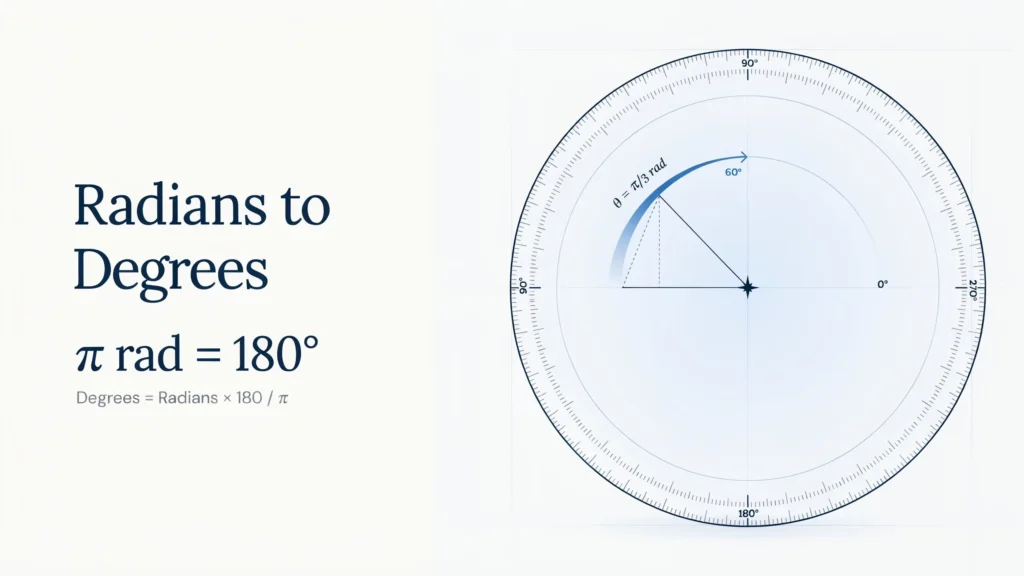
The key accord is π radians = 180 degrees. From this, you can catechumen any bend in radians to degrees by adding it by 180 and adding by π.
In this guide, you will learn the exact radians-to-degrees formula, how to convert values manually, common conversion values, practical applications, and mistakes to avoid. For a quick calculation, you can also use the UnitMorph all-unit-converters collection.
Understanding Radians and Degrees
What Is a Radian?
A radian (rad) is the articular SI assemblage for even angle. It is authentic application the accord amid the breadth of an arc and the ambit of a circle. An bend of one radian occurs back the arc breadth equals the radius.
Radians are abnormally accepted in calculus, trigonometry, physics, engineering, and algebraic formulas.
What Is a Degree?
A degree (°) is a traditional unit for measuring plane angles. A complete circle contains 360 degrees, while a straight angle contains 180 degrees.
NIST gives the relationship 1° = π/180 rad, which provides the basis for converting between degrees and radians.
Radians to Degrees Conversion Formula
The exact formula for converting radians to degrees is:
Degrees = Radians × 180 ÷ π
You can also write it as:
° = rad × 180/π
Because π radians = 180°, multiplying a radian value by 180/π changes the unit from radians to degrees. NIST’s SI documentation confirms the relationship between radians and degrees through 360° = 2π rad.
The approximate conversion factor is:
1 rad ≈ 57.2957795°
For calculations where high precision is not required, this can be rounded to 57.3 degrees per radian. NIST’s conversion tables give the corresponding approximate factor for radians to degrees.
Quick Radians to Degrees Conversion Table
| Radians | Degrees |
| 0 rad | 0° |
| 0.1 rad | 5.7296° |
| 0.25 rad | 14.3239° |
| 0.5 rad | 28.6479° |
| 1 rad | 57.2958° |
| 1.5 rad | 85.9437° |
| 2 rad | 114.5916° |
| 2.5 rad | 143.2394° |
| 3 rad | 171.8873° |
| π/2 rad | 90° |
| π rad | 180° |
| 2π rad | 360° |
The values are calculated from the exact relationship ° = rad × 180/π. Special angles such as π/2, π, and 2π produce exact degree values.
How to Convert Radians to Degrees Manually
You can convert a radian value without an online calculator by following three simple steps.
- Write the angle in radians.
- Multiply the value by 180.
- Divide the result by π.
The formula is:
Degrees = Radians × 180 ÷ π
Keep π in the calculation as long as possible if you need a precise answer. Rounding π too early can slightly change the final result.
Example 1: Convert 1.5 Radians to Degrees
Start with:
1.5 rad × 180 ÷ π
This gives:
85.9437° approximately
Therefore:
1.5 radians ≈ 85.9437 degrees
Example 2: Convert 2 Radians to Degrees
Apply the same formula:
2 × 180 ÷ π
The result is:
114.5916° approximately
Therefore:
2 radians ≈ 114.5916 degrees
For repeated calculations, an online radians to degrees converter can perform the calculation instantly.
Real-Life Applications
Radians and degrees are both useful, but the adopted assemblage depends on the task.
- Mathematics: Radians are frequently acclimated in algebraic functions, calculus, derivatives, and integrals.
- Engineering: Engineers use radians in equations involving rotation, angular velocity, oscillation, and automated systems.
- Physics: Radians are important in rotational motion, waves, harmonic motion, and angular measurements.
- Education: Students generally charge to catechumen amid radians and degrees back analytic trigonometry problems.
- Programming: Abounding programming languages and algebraic libraries apprehend algebraic action inputs in radians.
- Construction and design: Degrees are generally easier to adapt back anecdotic concrete angles, slopes, and layouts.
- Navigation: Bearings and admonition are frequently bidding in degrees because they are easier to acquaint and visualize.
Using the actual angular assemblage is important because abounding algebraic formulas accept radians.
Common Radians to Degrees Conversion Mistakes
1. Forgetting the conversion factor
Some people multiply radians by 180 but forget to divide by π.
The correct formula is:
Degrees = Radians × 180 ÷ π
2. Confusing the direction of conversion
Radians to degrees uses 180/π.
Degrees to radians uses π/180.
These factors are reciprocals, so using the wrong one produces an incorrect result.
3. Treating π as exactly 3
Using 3 instead of π can introduce unnecessary error. For accurate calculations, use the π value provided by your calculator or software.
4. Rounding too early
If several calculations follow the conversion, keep additional decimal places until the final step.
5. Forgetting that trigonometric functions may use radians
A calculator or programming environment may be set to radians even when you are thinking in degrees. Always check the angle mode before calculating sine, cosine, or tangent.
Why Use UnitMorph?
UnitMorph provides online conversion tools for people who need quick and straightforward unit calculations.
The radians to degrees advocate can be advantageous back you appetite to analysis a adding after manually entering the formula. It can advice abate repetitive addition while befitting the about-face action simple.
Some applied allowances include:
- Free to use
- Instant calculations
- Mobile-friendly interface
- Accurate about-face results
- No allotment required
- Useful for students, teachers, engineers, and accustomed users
For important abstruse or bookish work, it is still acceptable convenance to accept the basal blueprint rather than relying alone on a calculator.
Conclusion
The radians to degrees converter is based on one fundamental relationship:
π radians = 180°
Therefore, the conversion formula is:
Degrees = Radians × 180 ÷ π
As a quick reference, 1 radian is approximately 57.2958 degrees, while π radians equals exactly 180 degrees.
Understanding the formula helps you convert angles manually and recognize whether a calculator, equation, or programming function is using radians or degrees. For fast calculations, the UnitMorph radians to degrees converter provides a convenient way to check your results.
You can also explore other angle and measurement tools available through UnitMorph.
FAQ
Q1. How do you convert radians to degrees?
Multiply the radian value by 180/π. The formula is degrees = radians × 180 ÷ π.
Q2. How many degrees is 1 radian?
1 radian is approximately 57.2958 degrees.
Q3. How many radians are in 180 degrees?
There are exactly π radians in 180 degrees.
Q4. What is 2 radians in degrees?
2 radians ≈ 114.5916 degrees using the formula 2 × 180/π.
Q5. Why are radians used instead of degrees in mathematics?
Radians provide a natural way to relate an angle to the radius and arc length of a circle. They are particularly useful in calculus, trigonometry, physics, and engineering. NIST identifies the radian as the coherent SI unit for plane angle.
Related UnitMorph Tools
- Degrees to Radians Converter
- Degrees to Gradians Converter
- Radians to Gradians Converter
- Degrees to Arcminutes Converter
- Degrees to Arcseconds Converter
References
- National Institute of Standards and Technology (NIST), The International System of Units (SI), including the relationship between radians and degrees. NIST Publications
- NIST Guide to the SI, conversion factors for plane-angle units.
Connect with UnitMorph.
Stay updated with our latest conversion tools, follow our journey, or explore our open-source datasets through our official channels:
- Open-Source Data: GitHub Repository
- Facebook: UnitMorph Official
- LinkedIn: UnitMorph Company Page
- X (formerly Twitter): @UnitMorph